
Lake Floor Barriers (Benthic Barriers): The Complete Guide
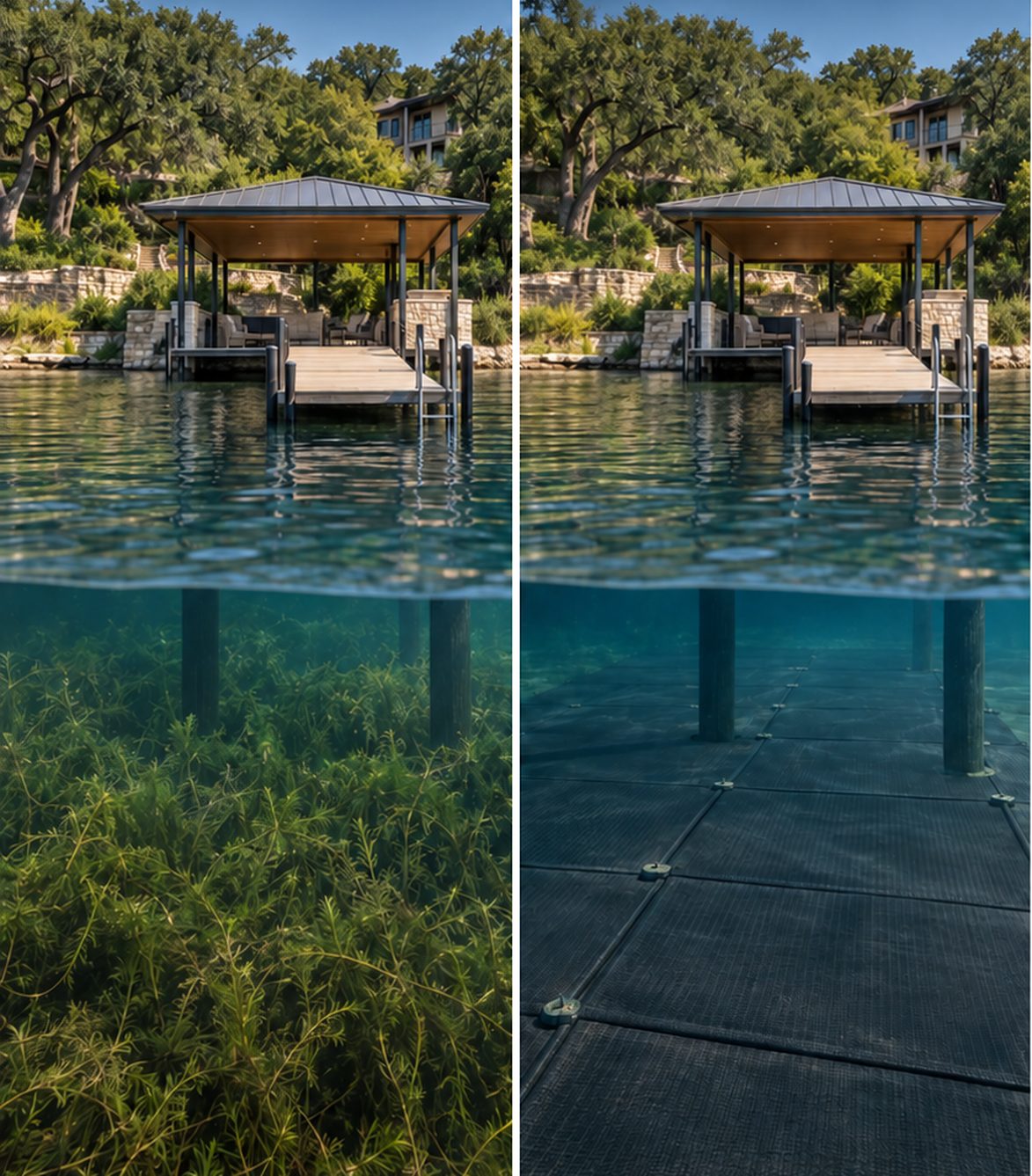
A lake floor barrier, also called a benthic barrier or bottom barrier, is a durable mat laid on the lake bottom to stop rooted weeds like hydrilla from growing in a specific area. Here's how it works, how it's installed around a dock, and what to expect over time.
How a barrier stops hydrilla
Hydrilla needs two things: sunlight and a bottom to root in. A barrier takes away both. Plants under the barrier can't photosynthesize, and new fragments can't root through it. Because it's physical, not chemical, nothing goes into the water, which matters on Lake Austin, where herbicides aren't used.
Where barriers make sense
- Boat slips and dock approaches, where hydrilla wraps props and lower units
- Swim areas and beach entries, where you're standing or wading
- Paddleboard and kayak launches, where you need a clear path out past the weed line
Barriers are for defined zones, not whole coves. Most projects start at a few hundred square feet around the part of the waterfront you use most. See packages.
How installation works
- Assessment: depth, slope, bottom type, and the layout of pilings, lifts, ladders and intake lines.
- Permit: TPWD approval for work in public waters. More on permits.
- Clearing: existing hydrilla is cut and pulled, and fragments are bagged and removed.
- Install: barrier panels are laid, fitted around every piling and cradle, and anchored for your depth and conditions.
- Optional sand finish: a layer of clean sand over the barrier for a soft, natural swim-area floor.
Maintenance: the honest version
No lake bottom stays perfectly clean. Silt settles on top of a barrier over time, and a drifting fragment can try to root in it. Gas from decomposing material underneath can also lift a poorly anchored barrier. That's why proper anchoring matters, and why periodic inspection and cleaning is part of keeping a zone clear. Done right, a barrier zone stays clear season after season with far less work than cutting.
Barrier vs. barrier + sand
The barrier alone clears the hydrilla and is the go-to for slips and boat approaches. The sand finish is for places you'll put your feet: swim areas, beach entries and shallow launches. It turns the zone into something that looks and feels like a natural sandy bottom.
Common questions
Will it hurt fish? Barriers cover small, defined areas around docks and swim zones. The rest of the lake, including the vegetation bass use for cover, is untouched.
Can it go around my boat lift? Yes. Barriers are cut and fitted around lift cradles and pilings during install.
What if I want more coverage later? Barrier zones can be expanded. Many owners start with the slip and add a swim area the next season.
Free on-site assessment. Chemical-free. TPWD paperwork handled.